
The JADE Student Learning Undergraduate Conference 2016, by Andrea Hernandez Hernandez
On the 1st of June Keele University hosted the very first JADE Student Learning Undergraduate Conference. The event’s slogan was by undergraduates for undergraduates and indeed it was. This event offered an excellent platform for UG students to experience delivering verbal and poster presentations.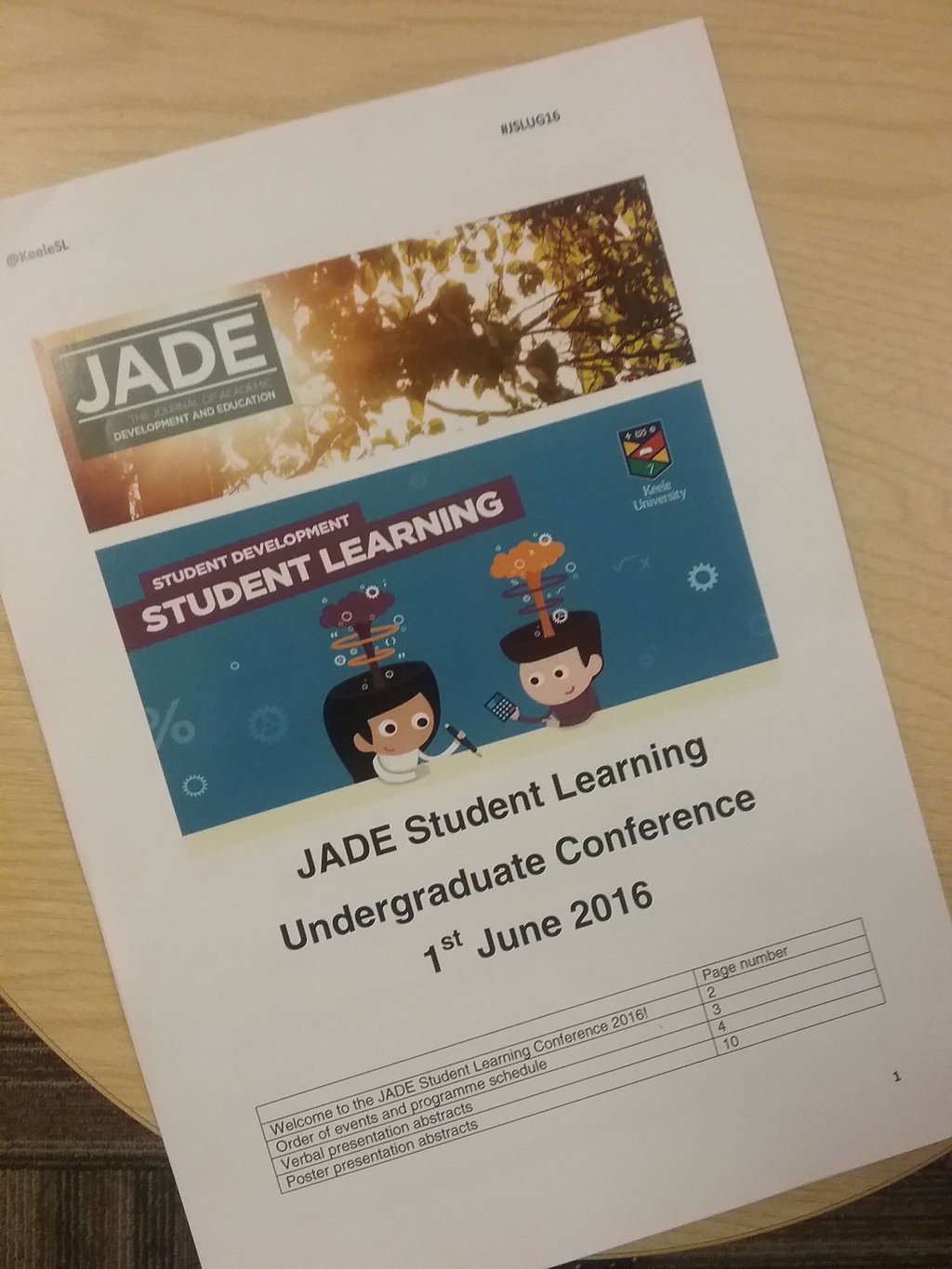
The event was opened with a warm welcome from Dr. Chris Little follow by the Pro Vice-Chancellor (Pro-VC), Professor Fiona Cownie, who with a full lecture theatre shared her path into the research through her keynote “The lived experience of academic research” outlining that we live in a daily research settings, in this setting we generate unpublished thoughts born through our curiosity and knowledge desire.
The conference held a total sixteen presentations covering a broad range of topics, ranging from the awareness of silent letters in English learners (Sercan Karakas & Ayse Gul Ozay), interesting studies of time perception in musicians and non-musicians (George Solomou) to the complexity of the implementation of a sensory hypersensitivity perspective as a new approach to address Autism (Steph Lonsdale). Every verbal presentation was followed by an audience discussion focusing on what they like about the presentation, what they could take from it as a future reference and provided a feedback to the presenter. This activity was benifical for the audience and the presenter as the presenter received powerful and encouraging comments and the audience picked up helpful tips.
The exhibition suite was full of excellent posters covering clinical, physiological, social, economic and political topics. Lots of comments from the poster presenters were received, the majority of them saw the conference as a great and enriching opportunity. To mention examples of the work exhibited and the presenter’s opinion, Kerry Exon, presented a poster titled “Delayed Cord Clamping” a topic that she is passionate about and could potentially turn into her research project. Kerry mentioned that it was great to be involved in an event like this and that it was a really helpful and excellent experience. Desire Gogo-fyneface shared her interesting third-year research project, “Use of stem cells for ameliorating age-related hearing loss”. She referred to the conference as a great opportunity to show her work with people that have the same or similar interest. Desire has never been in an event like this before and she felt that it absolutely boosted her confidence.
The JADE Student Learning Undergraduate Conference was a successful event that allowed UG students to present their high-quality work through a learning and formative experience. Additionally, enable them and other UG students to get a flavour of the fascinating topics and studies that other Keele students carried out, broadening their knowledge, interests and perspectives.
The conference held a total sixteen presentations covering a broad range of topics, ranging from the awareness of silent letters in English learners (Sercan Karakas & Ayse Gul Ozay), interesting studies of time perception in musicians and non-musicians (George Solomou) to the complexity of the implementation of a sensory hypersensitivity perspective as a new approach to address Autism (Steph Lonsdale). Every verbal presentation was followed by an audience discussion focusing on what they like about the presentation, what they could take from it as a future reference and provided a feedback to the presenter. This activity was benifical for the audience and the presenter as the presenter received powerful and encouraging comments and the audience picked up helpful tips.
The exhibition suite was full of excellent posters covering clinical, physiological, social, economic and political topics. Lots of comments from the poster presenters were received, the majority of them saw the conference as a great and enriching opportunity. To mention examples of the work exhibited and the presenter’s opinion, Kerry Exon, presented a poster titled “Delayed Cord Clamping” a topic that she is passionate about and could potentially turn into her research project. Kerry mentioned that it was great to be involved in an event like this and that it was a really helpful and excellent experience. Desire Gogo-fyneface shared her interesting third-year research project, “Use of stem cells for ameliorating age-related hearing loss”. She referred to the conference as a great opportunity to show her work with people that have the same or similar interest. Desire has never been in an event like this before and she felt that it absolutely boosted her confidence.
The JADE Student Learning Undergraduate Conference was a successful event that allowed UG students to present their high-quality work through a learning and formative experience. Additionally, enable them and other UG students to get a flavour of the fascinating topics and studies that other Keele students carried out, broadening their knowledge, interests and perspectives.

The JADE Student Learning Undergraduate Conference 2016, by Andrea Hernandez Hernandez is licensed under a Creative Commons Attribution-NonCommercial-ShareAlike 4.0 International License.
Based on a work at http://lpdcsolutions.blogspot.co.uk/.


JADE Conference 2016 by Aniqa Ashraf
Looking to broaden your knowledge on some of the most fascinating undergrad research topics? This is exactly what I did on the 1st June. Come hither the day of students gathering around to share knowledge on their chosen specialities.Stepping into the exhibition suite, it hits you straight away; the vast array of colourful posters hanging on the wall inviting you to come and take a closer look.
This was just a taster, there was yet more to come. Receiving the programme for the day, I could see a wide range of intriguing talks which were to be delivered by undergraduate students from Keele University. Topics ranged from, psychology and mindfulness to politics and geography, mental health a full lecture theatre on ‘An alternative approach to Autism?’ There were many talks to choose from, making the decision only harder on which talks to attend.

Before the day began, there was time to refresh with coffee/snacks and prepare for the fascinating talks yet to come. I attended a talk called, ‘below the breadline’ which made some interesting links between childhood poverty and education standards in areas such as Staffordshire. It was somewhat of a wake-up-call reminding us all that poverty may still exist closer to home than you may think. I had no knowledge of this as I’m sure you may not have either.
Then came a presentation on mental health which evoked many questions and interest during question time. The shocking statistics, such as ‘mental health accounting for 23% of the UK disease burden’ felt very prominent and remained with me throughout the day. Additionally, the statement of a “third world mortality in a first world country” is something that would stick with you. Wouldn’t it? Finishing with the thought provoking quote, “valuing mental health equally with physical health’ was a lovely ending.
Next came one of the highlights of my day, a talk on Autism by a student with Autism. This was a talk which was particularly heart-warming and moving for me as I am close to someone with Autism. The presentation was extremely captivating (the full lecture theatre is proof of this) and helped everyone and myself to gain some sort of understanding, whether large or small, of what it is like to live with Autism. The room erupted with a large round of applause and for me, this was without a doubt the cherry on top of a wonderful day and will be one of the highlights of my student life here at Keele!
JADE Conference 2016 by Aniqa Ashraf is licensed under a Creative Commons Attribution-NonCommercial-ShareAlike 4.0 International License.
Based on a work at http://lpdcsolutions.blogspot.co.uk/.
Comments were also shared throughout the day on twitter a storyfi of the activity can be seen below

