Showing posts with label Feedback. Show all posts

Friday, 16 March 2018

My experiences with technology-enhanced learning

By Dr Martyn Parker, School of Computing and Mathematics, Keele University 

Early in my academic career, I recognised that I had fallen into the same educational traps as many of my colleagues. At this stage, I worked in a department full of blackboards, and my initial attempts at educating students were identical to my experiences as a student.

A walk around mathematics departments the world over usually reveals corridors and rooms full of blackboards. It is not atypical for lecturers to fill blackboards several times over rather than use a few sketches or keywords. Other subjects use modern presentation tools and other learning methods, why not mathematics?


A typical mathematics department blackboard covered in technical mathematics. Image licence: The image is released free of copyrights under Creative Commons CC0. You may download, modify, distribute, and use them royalty free for anything you like, even in commercial applications. Attribution is not required.) 1 


Completing my first year teaching in higher education made me challenged myself to provide an excellent education that confronted the traditional blackboard method of university mathematics education. The entrenched view among mathematician that blackboard ‘chalk and talk’ is the only way at university and the ease with which I followed the ‘standard path’, meant I needed to demonstrate clear benefits to both staff and students of any alternative. This journey started before I joined Keele when I recognised early in my career that emerging technologies presented the opportunity to advance my educational practices. Nevertheless, it was not until I joined Keele that I made progress in developing both my practice and that of my peers.

I joined Keele in 2010 and challenged myself to demonstrate that mathematics education did not need to use nineteenth-century tools—the blackboard (or whiteboard). In particular, I wanted to demonstrate that appropriate technology has all the (perceived) advantages of the blackboard-based methods and can improve the student experience.

Mathematics is characterised as a `network of norms’ where interconnectedness must be material manifest2 . This networking of esoteric language is one reason so many departments use blackboards/whiteboards; learners need to see and engage mathematics as a process that creates the network and interconnected relationships3. For this reason, any technology that attempts to enhance mathematics education must continue to show these abstract ideas develop4 ; that is, replacing `chalk and talk’ with `PowerPoint and talk’ is not the answer!

Several stages characterise my approach. Rather than take these stages chronologically, it is better to discuss these by area. Below I summarise these areas, provide examples, detail the tool necessary to replicate them and some of the broader impact on the department.

Technology-enhanced delivery. My modules utilise a Tablet PC with a stylus (henceforth called a Tablet, the essential characteristic is a screen and stylus that can write directly on the screen). I employed a three-component framework5 consisting of a deficit, where technology provides missing support for learning activities; substitution, where a traditional element is replaced with a technology-based activity; enrichment, where technology offers a choice that complements existing materials. Tablets immediately address the three components. Specifically, they are a substitute for traditional blackboards, replicating the best features of blackboards: speed, space, visibility and legibility. They address the deficit of blackboards by providing the ability to switch between multiple delivery methods such as videos, quizzes, information delivery and Internet web pages allowing for breaks, consolidation periods and changes of activity within the class. Once complete, class material is uploaded to the KLE. This change in practice has impacted students with specific learning disabilities positively, rather than struggling to copy content from the board, they actively listen, knowing the written component is available to them after class.
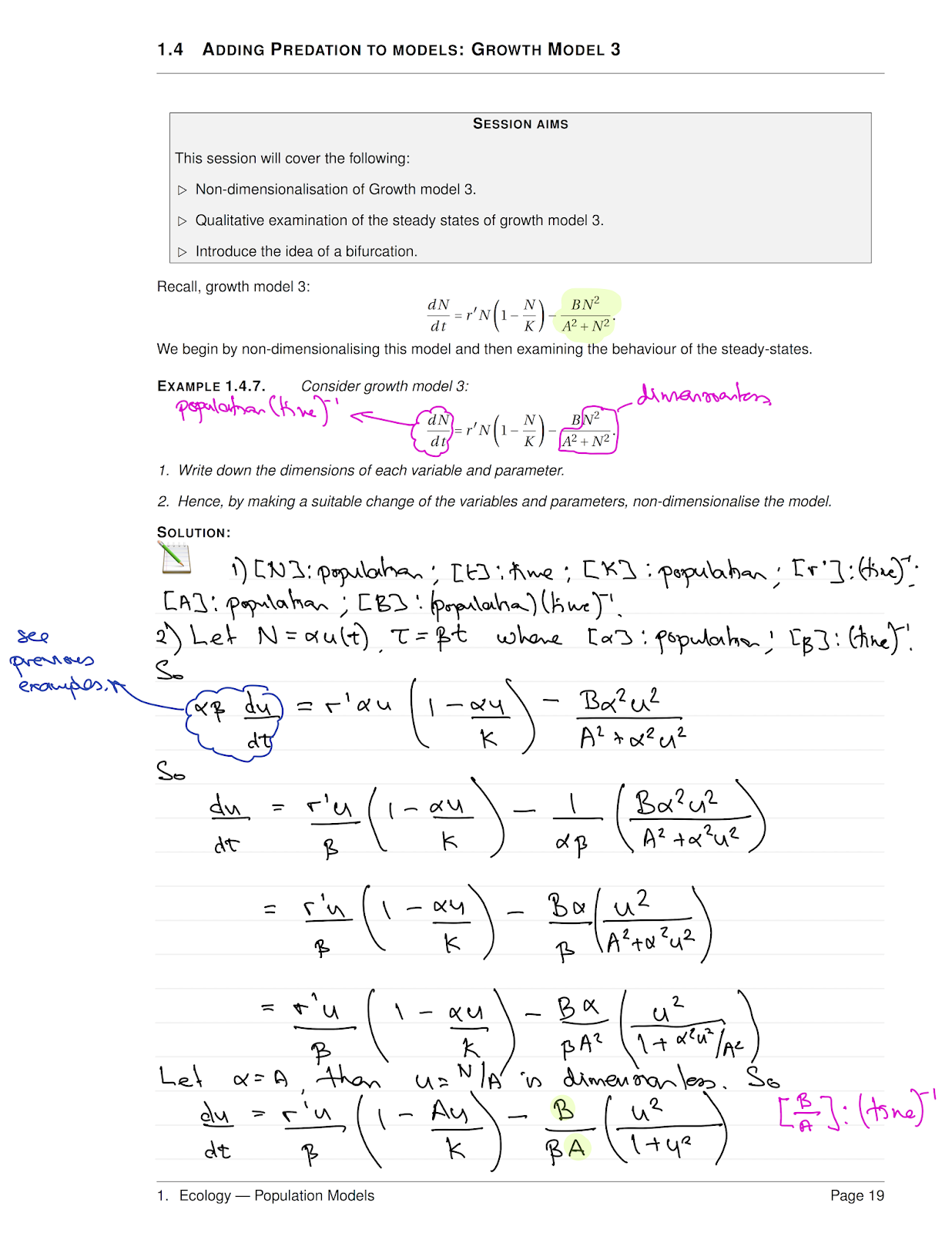
Sample page from a class show a mixture of prepared material and content produced live. Students receive these gapped notes at the start of the module. They complete the examples with the class leader, engaging with mathematics as they do.
A short sample video taken from the lecture Playback demonstrating how the static image evolved during the class. Note, the video’s sound is muted due to students asking and answering questions. Furthermore, for brevity the video is sped up.) 

Equipment requirements: A standard Tablet PC with a stylus. Microsoft Office provides annotation tools. The department utilise software called PDF Annotator since staff outputs are typically PDFs.

Departmental impact: In 2010, no staff except me utilised a Tablet for class delivery, now almost all staff now utilise a Tablet to deliver their classes. The School issues all new mathematics staff with Tablets.

Feedback. A five-minute video is likely to contain the equivalent of 500 - 600 words of written feedback, so a video provides ‘more’ feedback. This advantage, however, must be tempered with the fundamental idea that quality is better than quantity. Social changes mean greater student exposure to visual and audio media and research suggests better students response to multimodal feedback, where the tutor’s voice and the visuals convey relevant information. For students with, for example, dyslexia, students receive visual and oral information. From the mathematical perspective, video feedback permits students to experience the process of mathematical reasoning, seeing ideas materialise in front of them; that is, mathematics is visualised as a process and not a product, a key reason cited by mathematicians for blackboard use6. The videos are embedded directly into the module KLE page.


A short sample of class test feedback

Equipment requirements: A standard Tablet PC with stylus and screen recording software such as Camtasia or Snagit.

Departmental impact: The percentage of students agreeing that ‘feedback on my work has helped me clarify things I did not understand’ rose from 68% agree or strongly agree in 2010 to 81% in 2016. The 2016 result compares to a sector average of 71%. The 2017 result for `I have received helpful comments on my work’ is 89%, above the 73% sector average.

Video tutorials and problem-classes. I wanted to increase student engagement with formative assessment. Using Tablet PCs, screencast technology, YouTube and the KLE I created pre-recorded online classes. The classes’ structure consists of online tutorials, supporting formative assessment material together with online feedback on the formative assessment. Learners engage with the content at their pace and can move onto a new tutorial when they judge they have achieved particular outcomes. The aim being for students to regulate their learning.


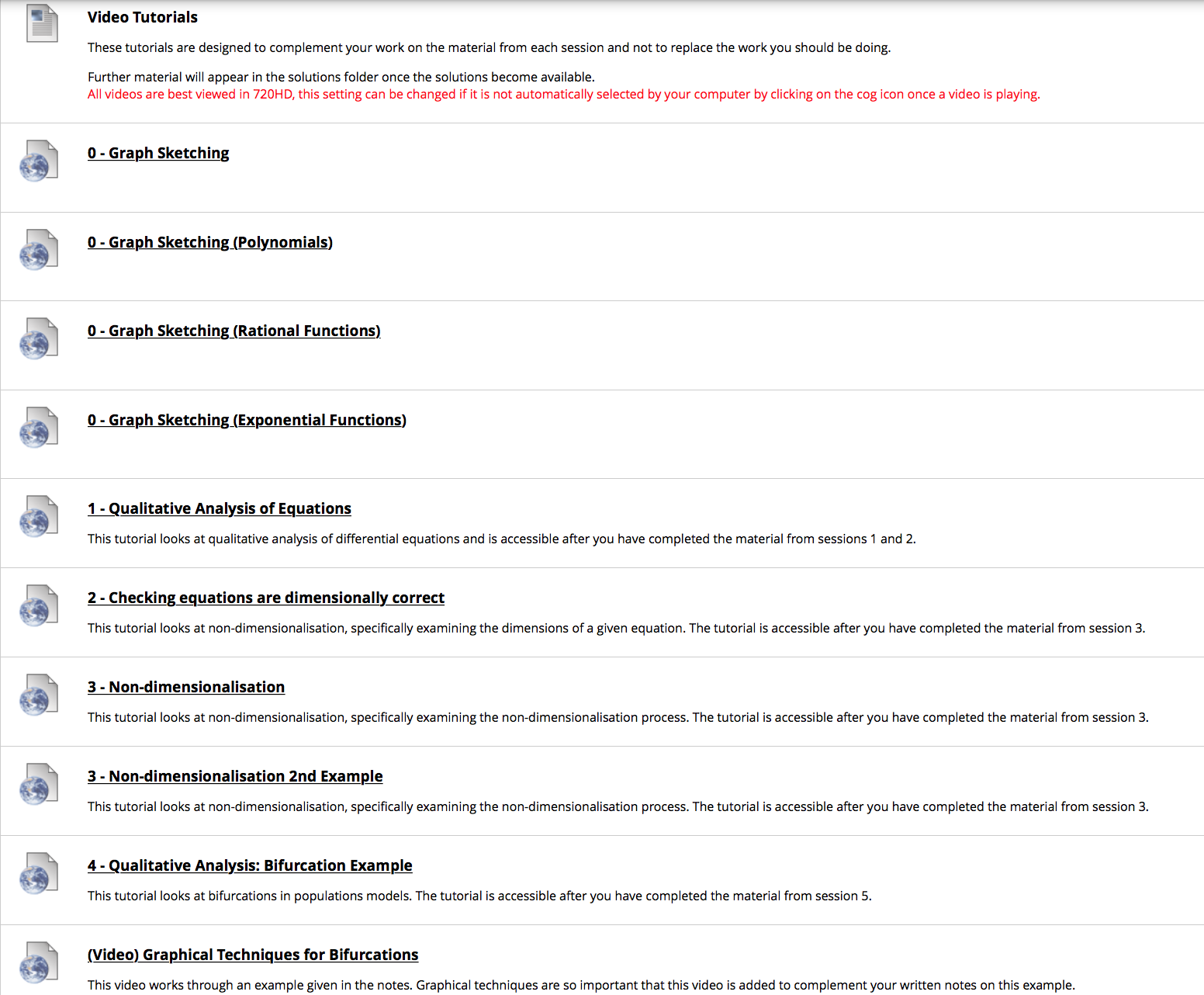
Example suite of video tutorials for a mathematics module.


Example tutorial videos and support materials. This tutorial covers the “Video Tutorial for Interacting Species” in the previous image.


Equipment requirements: A standard Tablet PC with stylus and screen recording software such as Camtasia or Snagit.

Departmental impact: Other members of the mathematics department now create video tutorials for their modules. I supported and mentored staff in the use and development of materials. The department currently has 765 videos that include feedback and tutorials. The analytics demonstrate student engagement that presently stands at 108,000 minutes watched from 23,500 video views. (These videos are only available to Keele mathematics students registered on the relevant modules.)

Multimedia-based assessment. I took the Keele-led in a National HESTEM Programme Grant on ‘Mathematical Modelling and Problem Solving’. The project’s primary aim was to aim to create a sustainable model that provides STEM undergraduates with the transferable skills and abilities to solve real-world problems. To meet this aim I designed a new module where students needed to create creative instructional videos that demonstrate the solutions to problems. The grant funded video cameras with students using free software to edit their creations. Students participated in the evaluation of each other’s presentation, with the department’s academic staff acting as facilitators and possessing the final say on marks. This approach provides a variant on Adaptive Comparative Judgement (ACJ) which is relatively untested in mathematics but has been employed in less creative settings7. The ACJ variant used is appealing since it is well suited to assess creativity and I wanted to determine its applicability as a peer-assessment tool. Engagement with this assessment was phenomenal. In all cases, students not only solved complex mathematical problems but provided incredibly creative video presentations of their work.

The video cameras found a second use. The School provides these to students preparing for presentation as a self-reflection tool so that they can film, watch and reflect on their presentations, creating their formative self-assessment.

Equipment requirements: Purchasing video cameras is optional; more recently, students use their mobile phones and free editing software. There is more to say, for example, recent developments include using YouTube's live streaming facility to escape from a physical classroom. Recognising there is more to say and looking back reveals the ever-changing ability for technology to enhance both the student and staff experience. The enhanced student experience is summarised by the words of a current student's response to their learning experience that "...brings Keele maths department into the 2010s." For me, technology has improved not only my practice, not only regarding student education but also my ability to effectively focus on education rather than just writing. It is worth closing by reminding ourselves that technology is one of many tools available to us and we must always be mindful of the words "the right tool for the right job".

1Phhere. (2017). The free high-resolution photo of writing, blackboard, math, research, text, handwriting, mathematics, lecture, presentation, insight, chalk board, abstract algebra, critical thinking, definitions, propositions, deductive reasoning. [Online] Available from: https://pxhere.com/en/photo/973959 Accessed: 14 February 2018.
2Wittgenstein, L. (1978). Remarks on the Foundations of Mathematics. Oxford:Basil Blackwell.
3Mason, J. (2002). Mathematics Teaching Practice: A Guide for University and College Lecturers. UK: Horwood Publishing Limited.
4D. O. Tall, D. O. and Mejia-Ramos, J. P. (2006). The long-term cognitive development of different types of reasoning and proof. In Hanna, G., Jahnke, H. N., and Pulte, H., editors, Conference on explanation and proof in mathematics: Philosophical and educational perspectives, pages 1 – 11. Universiat Duisburg-Essen, Campus Essen.
5Thorne, K. (2003). Blended learning: How to integrate online and traditional learning. Kogan Page, London.
6Greiffenhagen, C. (2014). The materiality of mathematics: Presenting mathematics at the blackboard. The British Journal of Sociology, 65(3):502–528.
7Jones, I. and Alcock, L. (2012). Summative peer assessment of undergraduate calculus using adaptive comparative judgement. In Iannone, P. and Simpson, A., editors, Mapping University Mathematics Assessment Practices, chapter 17, pages 63 – 74. University of East Anglia.

Creative Commons License
My experiences with technology-enhanced learning, B by y Martyn Parker, School of Computing and Mathematics, Keele University is licensed under a Creative Commons Attribution-ShareAlike 4.0 International License.

Friday, 1 December 2017

Purple Pens: Enhancing Assessment Literacy and Student Engagement with Feedback through Students Writing Their Own Feedback

Dr Dave McGarvey, School of Chemical and Physical Sciences, Keele University

From an abstract submitted to https://www.heacademy.ac.uk/stem-conference-2017-poster-abstracts

The aim of this session is to describe and illustrate our experiences of a deceptively simple but effective strategy for improving the quality and timeliness of assessment feedback in large classes through the use of a tutor-led dialogic technique that involves students writing their own feedback using distinctly coloured pens. The objectives are to stimulate discussion of the distinctions between passive receipt of tutor-written feedback and students writing their own feedback in a tutor-led dialogic environment with a view to further enhancing students’ engagement with feedback and feedback literacy.
The UK Quality Code for Higher Education (Chapter B6) articulates indicators of sound practice as a basis for effective assessment [1]. Indicator 6 (developing assessment literacy) states:

‘Staff and students engage in dialogue to promote a shared understanding of the basis on which academic judgements are made’ [1].

This is followed by a narrative that commences: ‘Engaging students, and making use of examples and/or self and peer assessment activities, where appropriate, helps students to understand the process of assessment and the expected standards, and to develop their assessment literacy’ [1] and this captures the essence of the work described here. The use of dialogic feedback cycles provides examples of alternative approaches [2].

In the physical sciences the use of regular high-value, low-stakes paper-based assessments that typically involve calculations, analysis and interpretation of scientific observations and data (e.g. problem sheets, in-class tests) is common practice. Tutor experiences of marking such assessments are invariably characterised by observations of common errors /misconceptions, resulting in much of the feedback that is provided being repeated again and again, which is further exacerbated when dealing with large classes. The desirability of rapid turnaround times coupled with large classes presents challenges for the provision of detailed feedback, and is compounded by ineffectiveness due to the fact that many students do not understand the feedback, or do not read the feedback and only look at their mark.
We (David McGarvey, Laura Hancock, Katherine Haxton, Michael Edwards, Martin Hollamby) have recently trialled a tutor-led dialogic self-assessment method to enhance assessment literacy and feedback in selected high-value, low-stakes 1st year Chemistry assessments. The elements of the approach comprise (i) tutors surveying (but not marking, or writing feedback) completed assessments to inform the feedback to be provided (ii) prompt return of the unmarked work together with a distinctly coloured pen under controlled conditions (iii) interactive tutor-led assessment, during which students mark and write feedback on their own work with the distinctly coloured pen (iv) collection of the scripts to review marking and feedback annotations and (v) return of the work within a subsequent timetabled session.

From a detailed evaluation we have learned that students value this approach to provision of feedback for a variety of reasons, not least that the students have some autonomy over the feedback and can engage in dialogue with the teacher and peers.

‘I can make notes that make sense to me/explain things in the way that I understand them’’ (Keele student)
It is also quite efficient and provides an insight into students’ engagement with feedback. Detailed outcomes of the final student and tutor evaluation and examples [3] will be presented and discussed. Practical advice on adapting the methodology will be provided.

1. UK Quality Code for Higher Education, Chapter B6 (2013), http://bit.ly/2acRADP.

2. Chris Beaumont , Michelle O’Doherty & Lee Shannon (2011). ‘Reconceptualising assessment feedback: a key to improving student learning?’, Studies in Higher Education, 36:6, 671-687.

3. We thank Lydia Bennett (Keele chemistry undergraduate) for helpful comments and permission to use her annotations as examples.


Creative Commons License
Purple Pens: Enhancing Assessment Literacy and Student Engagement with Feedback through Students Writing Their Own Feedback by Dr Dave McGarvey, Keele University is licensed under a Creative Commons Attribution-ShareAlike 4.0 International License.
Based on a work at https://lpdcsolutions.blogspot.com/2017/11/developing-academic-practice-at-level-4.html.

Friday, 3 March 2017

Making feedback more rewarding for everyone. Dr Julie Hulme


This blog post has been contributed to Solutions by Dr Julie Hulme a Principal Fellow of the HEA, a National Teaching Fellow and Keele Excellence award winner. More about Julie can be found here

The National Student Survey has made universities look carefully at the feedback provided to students, and most have implemented initiatives to improve students’ satisfaction (which has nonetheless remained stubbornly low). This can be a source of frustration for academics, who note glowing external examiners’ reports, hours of diligent commentary on their students’ work, and then rage that some students never read their feedback.

As a psychologist, this piques my curiosity. How can students be dissatisfied with something that should help them to learn (and get better marks)? How can academics believe that they are doing a great job, and yet deliver something that is so fundamentally flawed that students don’t even bother to read it? There appears to be a communication problem, and further investigation is needed.

Since the communication problem exists on both sides of the feedback equation, I carried out some research addressing both student and tutor perspectives. Most previous research offered insight into the ways in which students thought we could improve, but tutors were left reeling at the prospect of ‘doing more’ within an already busy job. Could we get more effective AND more efficient?

I used a mixed methods approach, combining surveys and focus groups, to investigate the perceived purposes of feedback, what people thought helped learning, and how feedback was used. The results offered a surprising degree of agreement between students and tutors, and allowed me to generate a set of recommendations, which I shared with volunteer participants online. They commented on and amended the recommendations, until they reached a consensus.

So, what can we do to make the feedback process more satisfying, and less frustrating, for everyone concerned? Let’s start with what tutors can do:

  • Students value three types of feedback: what they do well, what can they improve, and how they can improve. My research shows that tutors tend to focus on what is wrong – but guidance on how to improve is the hardest type of feedback to give, but the type that is most useful. Practically, how do you expect the student to provide ‘more depth’? I now provide structured feedback under these three headings.

  • Don’t give feedback on every mistake; pick the issues that are causing the most problems, and give detailed and constructive feedback about these (for writing errors, point students at Student Learning – this will save you time, and get them some expert help, while avoiding them feeling ‘picked on’).

  • Remember your audience – we sometimes use comments to justify our marks for the second marker. But students may not understand academic ‘short hand’; what is ‘depth’, anyway? Use language that will engage and develop them. 

  • Audio comments can help to make feedback feel personal and make it more accessible.

  • Early in the course, talk to your students about how to use feedback as a tool for learning; feedback in schools and colleges is very different, so they need to learn a new approach.

  • Identify yourself - sign or initial your marking so that students know who to ask if they need any clarification.

And what can students do?

  • Firstly, read your feedback! It gives you insight into how to improve your grades in future, and, according to Hattie (1987), is the most important way you can improve your learning.

  • But don’t read it instantly. When you first get work back, you’ll be emotional. Either you’ll be dancing around celebrating, or you’ll react defensively to the feedback. Give yourself time to calm down and reflect; look for the information that tells you what you do well, what to improve, and practically, how you can get better (even if this isn’t written explicitly). Devise an action plan and follow it!

  • If you’re not sure how to use your feedback, ask for an appointment with the tutor who marked your work, and ask for their help. Communication is much clearer in person, and misunderstandings can be avoided. If still in doubt, pay a visit to Student Learning for more advice.

The important thing, whether you’re a tutor or a student, is to remember that feedback involves two people. Sharing responsibility for the communication process ensures that feedback is useful, valued, and facilitates learning. Applying these principles certainly makes feedback delivery more rewarding for me, and my students often give me positive feedback on my feedback!


Hulme, J.A. and Forshaw, M.J. (2009). Effectiveness of feedback provision for psychology undergraduate students. Psychology Learning and Teaching, 8, 1, 34-38.

Creative Commons License
Making feedback more rewarding for everyone by Dr Julie Hulme, Keele University is licensed under a Creative Commons Attribution-NonCommercial-NoDerivatives 4.0 International License.
Based on a work at https://lpdcsolutions.blogspot.com.

Thursday, 9 February 2017

Keele Learning and Teaching conference 2017

The annual Keele Learning and Teaching conference organised by the LPDC took place on the 17th January 2017 sponsored by our Journal of Academic Development and Education (JADE).  There were over 20 presentations during the day across a range of disciplines sharing innovative approaches to learning and teaching.

The day was drawn to a close by a Keynote from Professor Tom Ward DVC for Student Education at Leeds University focused on Strategies for Enhancing Learning and Teaching through Publication arranged in conjunction with The Higher Education Network Keele (THiNK).

All content in this post is published using the Creative Commons licence noted below.  If you find something of interest please feel free to contact the authors for more information
Creative Commons License
Keele Learning and Teaching conference 2017 by [relevant author from post], Keele University is licensed under a Creative Commons Attribution-NonCommercial-NoDerivatives 4.0 International License.
Permissions beyond the scope of this license may be available at www.keele.ac.uk/solutions.

Placing the learning at the centre of learning analytics Dr Ed de Quincey,

Presentation can be found here

The interaction and interface design of Learning Analytics (LA) systems is often based upon the ability of the developer to extract information from disparate sources and not on the types of data and interpretive needs of the user. Current systems also tend to focus on the educator’s view and very rarely involve students in the development process. We have used a User Centred Design (UCD) approach with a group of 82 second year Computer Science students to design LA interfaces (in the form of Dashboards) that will engage and motivate them as learners and personalise their own learning experience. A preliminary thematic analysis has suggested that their understanding of LA and their requirements for it are often formed by the limitations of the technologies and systems that they currently use within and outside of the University. We have found however that learners want to be able to access an overarching view of their previous, current and future learning activity e.g. in a timeline. We propose that the only way of truly creating a personalised, supportive system of education is to place the learner at the centre, giving them control of their own Learner Analytics.

From broad brushstrokes to fine detail: using open badges to recognise learning achievements Mr Dan Harding & Mr Matthew Street 

Presentation can be found here

Rather than discussing a work in progress or completed project this presentation looks forward to the potential of open badges for extending student learning and continuing professional development by visibly endorsing uncredited activities. Open badges have been used in education since 2011, founded by Mozilla. Used appropriately, they have the potential to open up closed learning environments (both physical and virtual) enabling learners to gain recognition for the wide range of activities they engage with. This might include adding value to the outcomes of learning, digital credentials (i.e. digitising on and offline experiences) and supporting the scaffolding of learning through gamification. For co-curricular activities, badges could be used to recognise HEAR related activities. For example, volunteering, institutional student awards and university employment opportunities such as student ambassadors. Open badges can also bridge the gap between education and employment, providing a digital representation of achievements and improving the authenticity of learner experiences. Finally, this presentation will explore the difference between a badge and open badge, focusing on the affordances provided by openness for the learner and institution (issuer). For example, an open approach offers greater portability, allowing learners to build a repository of credentials that encourage lifelong learning

Congratulations! You’re Engaged! Ms Emma Hedges 

As student numbers and diversity increases, there is a need to ensure that student retention, progression and completion rates are maintained and improved. The implications of dropping out before completion for students, the institution, families and future employment options are great. Between 33% and 42% of students consider withdrawing from Higher Education prior to completion and students are particularly likely to consider leaving during their first semester and after Christmas. It is clear that student retention is an issue that needs addressing, as much as levels of attainment. The Student’s Union believes it has a key part to play in retention as the three key sections- Academic, Social and Services - of the Student Experience must work in harmony in order to create the best environment for student retention and attainment. At the symposium, the Student’s Union would like to present certain case studies and reports to support the idea that the culture of belonging is one of the most important reasons that student’s stay at University. We will examine how an individual’s engagement with Student’s Union can aid with retention, and attainment, through engagement, representation and involvement; with particular reference to combating isolation through its extensive student engagement programme. 

Students’ conceptions of teaching quality – what is excellent assessment and feedback? Dr Jackie Potter 

This presentation explores what we can know about effective assessment and feedback by studying students’ nomination statements for Keele’s teaching awards. Published work on student conceptions of teaching excellence (Bradley et al 2015; Moore and Kuol 2007) has not focused on assessment practices. The session explores the themes emerging in the data and compares these to core principles of good assessment and feedback practice (for example, Nicol and MacFarlane-Dick, 2006). It compares the nature of the approach to the initial step of appreciative inquiry and speculates on the real potential value for such data to be part of a virtuous cycle of change and development to assessment and feedback practices. The session explores the nature of trustworthiness, credibility and validity of the data particularly in relation to how nominations are solicited or students are briefed in advance. 

Evaluating the impact of a journal club to enhance Masters student research literacy and decision making Dr Tom Laws 

The literature supports and prescribes the establishment of a journal club to increase the research literacy of post graduate students. There is burgeoning literature on the effect of journal clubs for nursing students even though Evidence Based Practice is the corner stone of their learning and quality control practices. The lecturers at Keele-Nursing established regular journal club meetings using an electronic interface using a framework where by student explored a range of methodologies prior to selecting a research approach for their research project. A content analysis of the student postings / discussions across five research methods was undertaken (Cohort studies, case control studies, RCTs, Survey design and Qualitative interview). We triangulated the research methodology literature with the lecturers understanding of the requisite knowledge base and the student’s on-line comments. We found that students displayed enthusiastic and informed interactions beyond lecturer expectations. There was a strong association between students’ ability to offer informed critique on a range of studies and what the research methodology literature recommended in design and evaluation of research quality. This outcome situated most students with an adequate knowledge base to justify why they had chosen a specific research methodology and reduced tutoring needed to design the research. 

Throwing caution to the wind: using drones to teach undergraduate students Dr Alexandre Nobajas 

Presentation can be found here

Unmanned Aerial Vehicles (UAVs), also known as drones, have become increasingly popular and feature regularly on the news, both for positive and negative reasons. However controversial, their use has proven to be successful in a myriad of applications which go from disaster management to agricultural surveying. Nonetheless, due to a lack of courses offering UAV training there is a current shortage of professionals capable of performing missions with UAVs satisfactorily, something this project aims to mitigate by introducing UAV training as part of the university offering. By designing and deploying a variety of activities, including letting them fly a drone independently, a cohort of year 3 Geography students were introduced to drone technology, in what it is likely to be the first experience of its kind in the UK. 

What’s a digital experience? Student perceptions at Keele Mr Matthew Street, Mr Dan Harding and Mr Tim Hinchcliffe 

Presentation can be found here

This presentation will provide an insight into information collected during Keele’s involvement with the JISC Student Digital Experience Tracker. During April 2016, Keele’s application to become a pilot institution was accepted, requiring the collection of feedback from students about their experience of the digital environment. In total, 20 higher and further education institutions took part, giving participants access to anonymised benchmarking data. Nine questions were set by JISC, linked to their work on digital capability (https://www.jisc.ac.uk/rd/projects/building-digital-capability) with a further 3 left open for institutions to define. Inclusion in the tracker was offered to all areas of the University, with programmes from each Faculty represented in the final survey. Despite only 2 weeks of data collection, 312 responses were returned. Initial reaction was that the University performs well against the benchmark data, with analysis focused on free text responses as the richest source of information. Headline findings will be discussed during the presentation, however, clear trends in the data relate to consistency within the KLE, increasing engagement during lectures and other areas of the University’s digital environment. This session will begin the process of disseminating these findings with the University, including those who took part, with a report to follow. 


Progress with PlayBack Mr Matthew Street and Mr Phil Devine 

Presentation can be found here

This presentation covers two strands, the first will focus on the evaluation of the PlayBack pilot in 2015/16. The second on the development of PlayBack as one tool in a growing suite of capture technologies available at Keele. A range of methods were used to collect evaluation data, these will be explored and the lessons learned discussed alongside trends from the qualitative data captured. The evaluation highlighted the student perception of benefit from using PlayBack and showed how students use the service. When looking across the published literature on lecture capture conflicting evidence is offered about the benefit of captured lectures to learning. Leadbeater et al (2013) discuss the high use of captured lectures by non-native speakers of English and students who have dyslexia. Describing the benefits to these students in the context of being able to revisit material, but also highlighting that in some cases high use can lead to surface approaches to learning. This demonstrates the need for students to be supported to use the generated resources appropriately, work completed by Cornock provides examples of this support. If lecture capture is considered a tool that creates supplementary resources for these resources to be educationally beneficial students need support in learning how to use them appropriately 


Thinking and practising like a lawyer Mr Mark Davys 

It has been suggested that learning is something that takes place within the practices of a particular community rather than an activity that is contextually neutral. The aim of this project is to: 
  • consider what it means to think and practice like a lawyer; 
  • discern and deploy activities to help students become members of (and participants in) the legal academic community, rather than acquirers of expertise in discrete subjects and discrete transferable skills; and 
  • (in the longer term) assess whether this aids learning and improves employability, whether in the legal academy, legal practice or elsewhere. 
This project is at an early stage. The aim of the presentation is to share ideas and thinking, rather than conclusions; to test the reasoning behind the project, start conversations and gain insight from other disciplines. 

The challenge of remote CV guidance; does audio feedback help? Ms Keren Coney 

Presentation can be found here

CV writing is a component of employability development and allows students to effectively present themselves to employers. The aim of this project was to investigate the use of audio feedback as a tool to aid students with improving their CVs; in particular, to determine if this form of feedback could enhance the depth of feedback, level of understanding gained by students and the extent to which the feedback could be perceived as more personal. Responses were sought from 40 students using a questionnaire. Participants were incredibly positive about the format of feedback: it was unanimously agreed that the audio format aided their understanding and provided greater depth and a majority stated that this form was more tailored and personal. As a result of this project, I have incorporated the use of audio feedback into my practice and have even started using this format when providing remote guidance on other career-related activities, such as personal statements for postgraduate applications. Some students stated that they would prefer written and audio feedback; in response to this, a colleague and I are currently investigating the use of screen capture software to provide feedback and have been awarded HECSU funding to carry out this research. Page | 10 

Pilot evaluation of medical student perception of a novel pharmacology-based game Dr Russell Crawford and Dr Sarah Aynsley 

Gamification in higher education has been gaining traction as a plausible and useful addition to the diversity of learning resources available to both teachers and students. We have invented a card-based, role-playing team game to help aid pharmacology learning in medical students. Feedback from teaching staff was overwhelmingly positive and most felt it had a place within the curriculum as a pharmacological learning aid. The aim of the current study is to determine whether a range of medical students who played the game perceived any benefit to pharmacology learning supported in this way. Here we present pilot data based on questionnaire data and theme analysis of free-text comments collected from students who played the game. We found that students perceived a wide range of positive benefits to learning pharmacology in this manner and in our discussion, we consider how best to capitalise on these perceived benefits. 


Active learning: using interactive tools to enhance learning Dr Chris Stiff 

Presentation can be found here

This talk examines the use of active learning tools to enhance students' engagement and learning of delivered materials. Traditional lectures involve students being passive recipients of learning. However, teaching research has shown that students retain more information and are more motivated when they are actively involved in the lecture. I will demonstrate two teaching tools - Poll Everywhere and Mentimeter - that can be used to enhance content and draw students into the lecture. These tools differ from others that are available in that they require very little set up and no special apparatus – responses are made via PC or mobile phone. I will also outline preliminary data that shows using these tools does increase student engagement and overall satisfaction with the teaching they receive. 

Swipe in: electronic student attendance Mr Alex Goffe, Mr Neil Herbert, Mr Nick Vaughan and Mr Dan Daw 

Presentation can be found here

The purpose of this project is to utilise the student Keele Card to take electronic student attendance within the Faculty of Medicine & Health Sciences using bespoke, in-house designed and built card readers using open source technology.  

So you’ve got big data? Mr Tim Smale 

Presentation can be found here (access for Keele staff only)

Over the last 10 years it has increasingly become commonplace to evaluate every aspect of a student’s course. “How happy are the students?”, “how are students doing on their course?”, “how are students doing on placements” and “are the placement areas suitable” are all common types of evaluations undertaken throughout the academic year. This data is then held separately and manually reviewed and reported on. This separation and manual processing has hampered professional courses such as Physiotherapy, Nursing and Midwifery which are required by their respective professional bodies to collect this data and report the results within short timeframes. Over the last three years Tim Smale and Pete Lonsdale have been developing a solution that helps to collect this information from staff and students, import data from the student record system and external regulatory bodies. This then presents this data to staff in reports that can be easily digested and shared securely. This presentation will give a high level overview of the system’s capabilities around data associated with clinical placements (Audits carried out on the placement locations, logs of serious / safeguarding issues, student placement evaluations and debriefing records between tutor and student) and potential to develop further. 

Learning together, evaluating together: an enhanced evaluation of inter-professional postgraduate learning Dr Chris Little and Ms Jane Jervis 

Presentation can be found here

This paper will detail an investigation taking place with post-registration, postgraduate learners in the School of Nursing and Midwifery. The project sought to investigate the impact of interprofessional learning with students of an Advanced Clinical Practice module. This module recruited 47 learners, from 6 professions, including nurses, pharmacists, physiotherapists, podiatrists, optometrists, and paramedics. The project utilised the student response system Mentimeter to gather 22 responses utilising an in-class evaluative survey consisting of both qualitative and quantitative questions. These responses equate to 47% of the cohort. Students were left, unattended, to complete the in-class evaluation using their own devices or iPads provided by the School. All students in the room completed this evaluation. This paper will present a discussion about the benefits and disadvantages of presenting students with in-class evaluations and what it may mean for the data gathered. The data gathered points to an extremely positive evaluation of interprofessional learning. Students noted that new perspectives this learning had added to their academic and clinical practices. This short paper will also prompt colleagues to consider the place of in-class evaluations in their own practices and the implications of this upon the traditional end of year module evaluation. 

Learning in public? Assessing with blogs Dr Matthew Wyman 

Presentation can be found here

This will be a quick overview of my experiences using blogs as an assessment tool on my second year module on Russian politics. It will review technical issues, the online off-line question, assessment briefs and evidence from outcomes and evaluation about the effectiveness of the approach. I'll argue that the technical issues presented are worth it in terms of the added authenticity of the exercise and the extra levels of creativity that the blogs release. I think this is an approach which may be of wide interest, as just about every subject we teach is faced with the challenge of effective public communication of its value. 

Applying interdisciplinary approaches in the liberal arts through ‘living labs’ Ms Ella Tennant and Dr Andy Zieleniec 

Presentation can be found here

The new Liberal Arts Programme has been designed to be both interdisciplinary and innovative in teaching and learning. This is reflected in the first year core module Understanding the World Through the Liberal Arts, which provides an introduction to perspectives and approaches from various disciplines in HUMSS. True to the liberal arts’ origins in classical antiquity, this also allows students to engage with theories and perspectives outside the classroom, in ‘living labs’. These ‘field trips’ to specific locations encourage exploration and application of knowledge and methodologies, through thinking and doing, in real living communities and physical and social landscapes. With specific examples of the ‘living labs’ approach, this presentation will argue that learning outside the classroom can generate creative interactive activity, which in turn leads to new thinking through engaged and participatory, interdisciplinary teaching and learning. The linking of classroom and field activities also provides the opportunity for students to develop critical-thinking and problem-solving skills. Integration of learning activities and problem-solving reflects the educational theories of Dewey, Vygotsky, and Piaget, which have informed the field of outdoor learning and pedagogy. 
‘Living labs’ and interaction with the surrounding environment is a reflection of the innovative nature of liberal arts at Keele. 

Embedding the Keele journey and reflective practice within the mathematics programme Dr Martyn Parker 

Presentation can be found here

Recent reports note the ‘skills challenge’ facing the UK both from employers perspective [High Fliers, London, 2016] and the university sector [Universities UK and UKCES, 2014, Universities UK, 2015]. In particular, universities must consider ‘how effective universities are at describing the skills of their graduates?’ [Universities UK, 2015] We argue further that a fundamental axiom for universities is: how effective they are at providing students with the means to articulate their skills? In the wider context, the Teaching Excellence Framework [Department for Business and Skills, 2016] explicitly notes employability and destinations as a metric. Thus, student ‘added-value’ and its implications for their employment has never been more important. We present a model used within the mathematics programme to develop student reflective practice, their self-awareness and their ability to recognise and articulate their `skills'. We also summarise preliminary results on the effectiveness of this model. 

Project Ponder: using clicker technology to make students think Dr Russell Pearson 

Project Ponder was conceived in 2014 with the aim of encouraging students to think more deeply and debate core chemistry topics as and when they are introduced during teaching sessions to improve student engagement, understanding, performance and retention. Phase 1 of the project involved 144 first year students receiving a clicker handset as part of their welcome pack for regular use during lectures, workshops and problem classes. Phase 2 dealt with the same cohort of students in their second year of study using more sophisticated clicker handsets for team based tasks and discussions that were strategically positioned at regular intervals during a range of formal teaching sessions. This two-pronged approach involving the use of two different clicker handsets for large group teaching sessions has resulted in 96% of students wanting even greater clicker usage on their course, with 90% preferring clicker handsets to using mobile phone technology and over three-quarters of the class preferring clicker-based teaching sessions to the flipped classroom approach. The pros and cons of clicker handsets when compared against other available voting technologies will be addressed and the additional instructor benefits of the work, alongside tips for optimum impact, will also be described. 

From flash fiction to flash reflection Ms Karen Taylor and Ms Helen Machin 

Presentation can be found here

This paper reports the initial findings of an exploratory study into the effectiveness of “flash reflection” to encourage social work students to develop critical reflection skills. “Flash reflection”, inspired by flash fiction, is a brief writing activity of no more than 250 words structured around a model of reflection. Critical reflection is a core requirement of the UK’s Professional Capabilities Framework (PCF) for social workers and it is believed to lead to positive social change in social work interventions (Morley, 2014). However, there is a paucity of empirical evidence about how social work educators can support students to develop critical reflection skills (Burr et al, 2016). To explore the effectiveness of flash reflection, a group of 20 social work students were asked to complete flash reflections after each day of a short, intensive module. A second phase will invite the students and educators involved in the flash reflection experiment to discuss their experiences during interviews and focus groups. Initial findings suggest that flash reflection encourages students to analyse their assumptions whilst also providing rich and immediate evaluations of taught sessions. Based on these exploratory findings, we argue that flash reflection may be added to other techniques to encourage social work students to develop critical reflection skills. 


Teaching the limits of technology through iPad usage in seminars Dr Rachel Bright 

Presentation can be found here

This paper will draw on recent pedagogical developments relating to using tablets in classroom learning environments as an integrated part of seminar interaction. It will demonstrate how iPad activities can encourage active and collaborative learning, both of which have been shown to improve academic performance (Kuh 2005, Prince 2004). This paper will specifically focus on sessions within History at Keele in 2014 and 2016, demonstrating how the technologies were used to improve student interaction, especially through group work and presentations, as well as how the iPads improved the class participation of students with a range of disabilities. As Rice (2011, para.3-4) has shown, ‘iPads increase engagement and collaboration, acting as a facilitator for more easily sharing information.’ However, this paper will also reflect on the limitations of using such technologies, which unexpectedly became evident during group work in these classes. A comparison was made between groups with iPads and those without; and occasionally the iPads proved a distraction, with worse outcomes. Rather than demonstrating that iPad use should be discontinued, however, the results subverted student expectations about using new technologies in a learning environment, constructively enabling them to reappraise how they approach research at university-level. 


Sustainability education at Keele; what do you think? Dr Zoe Robinson 

Presentation can be found here

This talk will present material from a staff (2013) and student (2015) university-wide survey looking at staff and student attitudes towards sustainability. It considers how staff and students conceptualize sustainability at Keele, how relevant they see it to their discipline, how they would like to see it implemented, and the impact that sustainability education work at Keele has had on the sustainability attributes of students from different disciplines. This data can inform future directions of education for sustainability work within the institution, and in particular highlights the importance of considering different approaches for different disciplines. 

Scrolling’ to map texts, cross academic conceptual thresholds and access the ‘critical’ reading portal Ms Angela Rhead

An example of scrolling can be found here

Interested in increasing students’ active and critical engagement with texts, I have been frustrated by attempts to move beyond the “scan the abstract” technique for the initial stages of reading, where criticality can be said to begin. Inspired by Middlebrook’s (1994) discussions on the benefits of creating scrolls from selected sources to explore reading processes collaboratively, and beginning with Y2 Music students, I experimented with scrolls to ‘map’ texts to precede (or circumvent) narrative reading. Twelve feet of a journal article, ten students and several marker pens later, scrolling appeared to increase students’, “dialogic engagement with the text “(Abbott, 2013, p.198) and uncover the easily recognisable but difficult to explain intuitive practices of confident academic readers (Moore, 2013); imperfect but profoundly improved, this year I have extended the experiment to a range of disciplines at undergraduate and postgraduate levels. One key finding is students’ widespread lack of understanding of the purpose of academic reading, a ‘conceptual threshold’ (Wisker and Robinson, 2009) that, unlike discipline-specific ‘threshold concepts’, describes epistemological cross-disciplinary concepts that require criticality on the part of the reader. A discussion of the emerging findings of this experiment provides the potential to focus on a significant aspect of higher learning that frustrates both students and academic staff.

Developing critical writing skills; a patchwork tour de force Ms Sara Morris 

Presentation can be found here

Aim: To develop confidence and a requisite academic skill set for level 7 in a disparate graduate cohort The ‘patchwork text' assignment commences at the start of the MSc Nursing programme and is gradually assembled during the course of an eight month module to meets all the learning outcomes. Winter (2003) suggests a Patchwork text approach as useful to creatively explore concepts. The assessment consists of a variety of formative short ‘patches’, using a range of written approaches (e.g. reflective account, annotated biography, report) each of which is complete in itself. These patches are developed around a theme (e.g. frailty) to ensure the overall unity of these component sections. Although the theme is planned in advance the work is finalised retrospectively, drawing on formative feedback, feed forward, discussion and peer review. The final assessment is complete when the revised ‘patches’ are 'stitched' together’ with a critical reflective commentary. So why this approach? The MSc Nursing is a fast track programme that recruits from a wide range of graduate disciplines, all of whom are new to the Nursing profession. The use of formative patches and a range of feedback mechanisms have been instrumental in supporting and upskilling the cohort to construct new knowledge that builds on previous learning (Matt, 2000) and introduces and the required academic skills in an accelerated manner to Masters Level. The opportunity for critical reflection in both the discussions and the ‘stitching’ has demonstrated a deeper level of understanding of complex and multi-dimensional areas of nursing practice.

Friday, 3 June 2016

Approach to providing feedback using screen capture, by Ella Tennant

The approach taken and why
I decided to use screen capture software to provide feedback on assessed work to two groups of International students on English for Academic Purposes modules. I felt that providing online audio/video feedback for work on English Language modules would increase student satisfaction and make the assessment and feedback process more effective overall. It would also enable students to understand the process of using a Turnitin Dropbox (TAD) and provide an extra support to students still struggling with the concept of originality in their work.

Work is submitted and marked using Grademark, according to predetermined criteria. The Grademark “labels” are colour-coded. Using screen capture, I talk through the comments, as I scroll through the document, highlighting particular areas or concerns. This recording is saved as an MP4 file and attached to the Grade Centre submission page for the student. Students are able to see their grade, the feedback and the MP4 file.

The students were very enthusiastic about the feedback format and in general found it encouraging. At the end of the semester, they were asked to complete a survey.

Advantages
Benefits of the approach for you and the students
The software, Snagit is very easy to set up and use. I am able to personalise the feedback and I feel there is more opportunity to give more complete feedback than if I am writing. I can make encouraging comments, suggestions from the general to the specific and provide pointers for future improvement. Even with Quickmark comments, the process seems to be less time-consuming than when giving full written feedback. The fact that the document with my comments is “captured” the student can see the part of the text I am highlighting as I talk.

Feedback from the students was very positive. Comments emphasised that it was like having a one to one tutorial, it was easy to follow, and they could clearly see how to improve on their mistakes and so on. 100% of respondents agreed that they found the screen cast feedback very helpful. 87% of respondents agreed that it was motivating to hear the tutor discussing the work and 93% said they listened to the recorded feedback rather than just look at the grade. 87% answered that they preferred audio/video feedback to traditional written feedback.

Disadvantages
Any unexpected outcomes or ways you would change your approach next time

Although a degree of written feedback was provided using Quickmark comments, I was surprised that some students (67%) commented that they would still prefer to have fuller written feedback on their work combined with screen-cast feedback.

The main drawback is that the software licence is limited to a specific computer, but I now also have this for my own computer which enables me to also catch up on marking from home. However, uploading the MP4 files to the Grade Centre page is a slow process when not using the Keele network.

Key recommendations
If you were talking to a colleague about the approach what would be the key things you would tell them to help them get the most from your approach

This short study convinced me that the use of technology to provide feedback has an overall positive effect on learning and teaching. I continue to use this approach and offer some suggestions to those considering adopting this:
  • Use a good microphone: I have a Snowball which works well
  • Be systematic in providing feedback, concentrating on areas in order according to the marking criteria
  • Always check that the file is saved and has uploaded
  • Explain clearly to students, with a demonstration, as to how they can access the feedback and check that they have been able to do so
  • Proficiency in providing clear, concise and helpful feedback does improve with practice.

Creative Commons License
Approach to providing feedback using screen capture by Ella Tennant, Keele University is licensed under a Creative Commons Attribution-NonCommercial-NoDerivatives 4.0 International License.

Sunday, 24 November 2013

Using Screencasting and Grademark to provide feedback, Dr Sheila Hope

In this recording (video file) Dr Sheila Hope outlines her experiences of providing feedback using Grademark and screen capture software Camtasia.  More specifically she describes the practical issues faced and compares the use of jing (freely available screen capture software) with Camtasia a more complex programme, and details how else she has been using Camtasia to support student learning.  In this project the general process followed was students would submit their assignment to a Turnitin drop box in the VLE where the work would be marked using Camtasia to record the comments and screen actions.

Saturday, 23 November 2013

Using audio to provide general feedback on exams, Dr Bill Dixon


Dr Bill Dixon (School of Sociology and Criminology) provides a description of his experiences of using audio to provide general feedback to all students on a module in relation to a multiple choice exam.
1.    In the project what technology and /or process did you use to provide feedback to students?
I wanted to provide generic feedback in an accessible format to first year students on an MCQ exam.  I recorded a sound file in MP3 format using a very simple recorder provided by the STAF project and uploaded it to the module section (CRI-10010 Understanding Crime) on the KLE.  

2.    Prior to the project how would you normally provide feedback to students?
In previous years I had provided written generic feedback in the form of a Word document posted on the KLE.  I was disappointed by the number of students accessing this feedback and given up doing so in 2009/10.
3.     Did you find providing feedback was more or less efficient than the process normally used?
Yes.  Although the process was new to me and I made several false starts with the recording, it took me no more than an hour to record and upload a 17 minute sound file.  Writing a Word document covering the same ground has taken me up to 2 hours in the past.
4.     Did using the technology allow you to provide richer or more detailed feedback to students when compared with the ‘normal’ process used?
It is hard to say whether the feedback provided in the sound file was richer or more detailed but it may well have seemed to be more immediate and personal.  But I have no hard evidence to support this hunch.
5.     Do you think that the students benefited from the change in feedback process? (Why? What is your data?)
With roughly similar numbers of students registered on the module the total number of visits to the audio file in 2010/11 from the date of release to 27th May was 52.  The corresponding number of visits to the Word document made available in 2008/9 was 29 over the same period.  
6.    From your perspective, what were the main advantages of using this process to produce feedback?
From my perspective the strengths of this process are the sense of immediacy (perhaps even intimacy) that a sound file provides and the time saved in creating such a file rather than a written document.
7.    From your perspective, were there any disadvantages to using this process to deliver feedback?
None.
8.    How do you think the process used could be improved to make it easier to use?
No - like most things, practice will make the process (more) perfect.
9.    Will you continue to use the intervention in your teaching practice? If not, what would need to change for you to adopt the intervention as current practice?
I would certainly use a sound file to provide generic exam feedback again.  Since using this technology to record feedback I have also used it to record an entire lecture which was then uploaded to the KLE.  

Friday, 22 November 2013

Using Screencasting to provide timely general feedback on assessments, Dr Katherine Haxton

Screencasting, also known as vodcasting, offers a means of providing mini-lectures working through answers to assessments that students can view at a time and place of their choosing, rather than being forced to listen in a timetabled class.  Crucially, screencasts of model answers and problem solving allow teachers to reveal their problem solving strategy, something not easily conveyed with written answers. 
We use a Toshiba tablet PC running Windows 7 and Camtasia Studio 7 and a digital voice recorder was used in place of the internal microphone to record high quality audio which was then edited into the screencast. The screencasts were edited before production of the video to remove any awkward pauses or stumbles.  This enabled the screencasts to be recorded in one attempt. Custom production settings were used within Camtasia Studio 7 to enable a table of contents to be produced in the finished video. This allows students to navigate to a specific part of the screencast, for example a specific PowerPoint slide title, enabling them to revisit content easily. Screencasts were approximately 5 minutes in length (the maximum length for online production) and took around 20 minutes to prepare, record and edit each after the initial learning curve. 
Screencasts were used to provide model answers to a number of class tests in the 2010/11 academic year including those involving spectroscopic data interpretation and main group inorganic chemistry. For first year Chemistry, screencast model answers and feedback were provided in addition to marked class test scripts, but the level of feedback offered on the marked scripts was reduced to only the key points and uncommon errors, and students were directed to consult the screencast model answer feedback.  
Screencasts were well received by the students with most rating them equal to or better than written, individual feedback. 
In particular, the opportunity to watch and see the problem solving strategy was identified as particularly useful:
“I found the video feedback to be very helpful.  It allowed me to look at my answers in the comfort of my own home, without using up valuable problem class / lecture time.  [The] commentary highlighted some points that would not have been easily conveyed in writing alone.” – First Year Student
Please see below for a more video of Dr Katherine Haxton explaining more