Showing posts with label KEA. Show all posts

Friday, 16 March 2018

My experiences with technology-enhanced learning

By Dr Martyn Parker, School of Computing and Mathematics, Keele University 

Early in my academic career, I recognised that I had fallen into the same educational traps as many of my colleagues. At this stage, I worked in a department full of blackboards, and my initial attempts at educating students were identical to my experiences as a student.

A walk around mathematics departments the world over usually reveals corridors and rooms full of blackboards. It is not atypical for lecturers to fill blackboards several times over rather than use a few sketches or keywords. Other subjects use modern presentation tools and other learning methods, why not mathematics?


A typical mathematics department blackboard covered in technical mathematics. Image licence: The image is released free of copyrights under Creative Commons CC0. You may download, modify, distribute, and use them royalty free for anything you like, even in commercial applications. Attribution is not required.) 1 


Completing my first year teaching in higher education made me challenged myself to provide an excellent education that confronted the traditional blackboard method of university mathematics education. The entrenched view among mathematician that blackboard ‘chalk and talk’ is the only way at university and the ease with which I followed the ‘standard path’, meant I needed to demonstrate clear benefits to both staff and students of any alternative. This journey started before I joined Keele when I recognised early in my career that emerging technologies presented the opportunity to advance my educational practices. Nevertheless, it was not until I joined Keele that I made progress in developing both my practice and that of my peers.

I joined Keele in 2010 and challenged myself to demonstrate that mathematics education did not need to use nineteenth-century tools—the blackboard (or whiteboard). In particular, I wanted to demonstrate that appropriate technology has all the (perceived) advantages of the blackboard-based methods and can improve the student experience.

Mathematics is characterised as a `network of norms’ where interconnectedness must be material manifest2 . This networking of esoteric language is one reason so many departments use blackboards/whiteboards; learners need to see and engage mathematics as a process that creates the network and interconnected relationships3. For this reason, any technology that attempts to enhance mathematics education must continue to show these abstract ideas develop4 ; that is, replacing `chalk and talk’ with `PowerPoint and talk’ is not the answer!

Several stages characterise my approach. Rather than take these stages chronologically, it is better to discuss these by area. Below I summarise these areas, provide examples, detail the tool necessary to replicate them and some of the broader impact on the department.

Technology-enhanced delivery. My modules utilise a Tablet PC with a stylus (henceforth called a Tablet, the essential characteristic is a screen and stylus that can write directly on the screen). I employed a three-component framework5 consisting of a deficit, where technology provides missing support for learning activities; substitution, where a traditional element is replaced with a technology-based activity; enrichment, where technology offers a choice that complements existing materials. Tablets immediately address the three components. Specifically, they are a substitute for traditional blackboards, replicating the best features of blackboards: speed, space, visibility and legibility. They address the deficit of blackboards by providing the ability to switch between multiple delivery methods such as videos, quizzes, information delivery and Internet web pages allowing for breaks, consolidation periods and changes of activity within the class. Once complete, class material is uploaded to the KLE. This change in practice has impacted students with specific learning disabilities positively, rather than struggling to copy content from the board, they actively listen, knowing the written component is available to them after class.
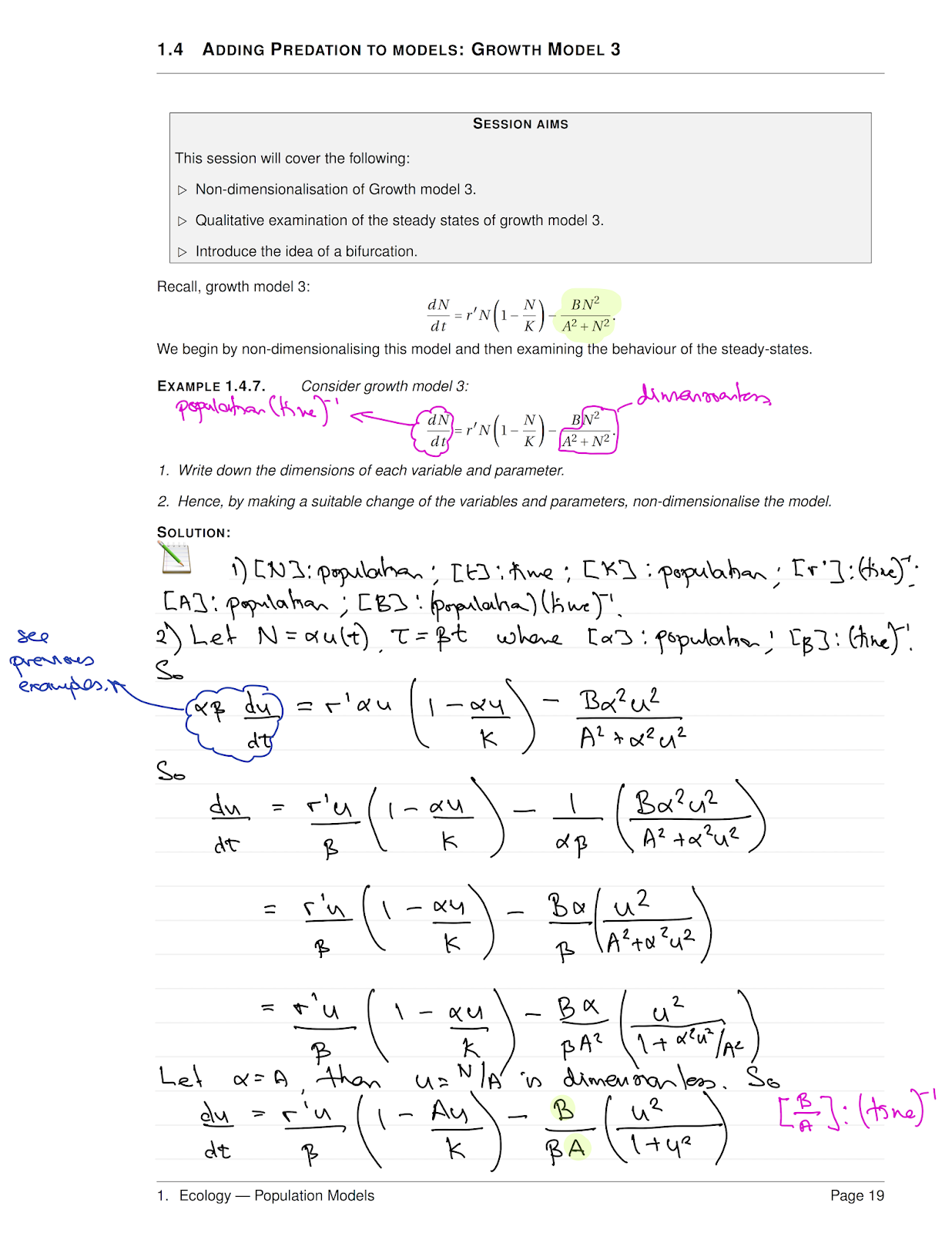
Sample page from a class show a mixture of prepared material and content produced live. Students receive these gapped notes at the start of the module. They complete the examples with the class leader, engaging with mathematics as they do.
A short sample video taken from the lecture Playback demonstrating how the static image evolved during the class. Note, the video’s sound is muted due to students asking and answering questions. Furthermore, for brevity the video is sped up.) 

Equipment requirements: A standard Tablet PC with a stylus. Microsoft Office provides annotation tools. The department utilise software called PDF Annotator since staff outputs are typically PDFs.

Departmental impact: In 2010, no staff except me utilised a Tablet for class delivery, now almost all staff now utilise a Tablet to deliver their classes. The School issues all new mathematics staff with Tablets.

Feedback. A five-minute video is likely to contain the equivalent of 500 - 600 words of written feedback, so a video provides ‘more’ feedback. This advantage, however, must be tempered with the fundamental idea that quality is better than quantity. Social changes mean greater student exposure to visual and audio media and research suggests better students response to multimodal feedback, where the tutor’s voice and the visuals convey relevant information. For students with, for example, dyslexia, students receive visual and oral information. From the mathematical perspective, video feedback permits students to experience the process of mathematical reasoning, seeing ideas materialise in front of them; that is, mathematics is visualised as a process and not a product, a key reason cited by mathematicians for blackboard use6. The videos are embedded directly into the module KLE page.


A short sample of class test feedback

Equipment requirements: A standard Tablet PC with stylus and screen recording software such as Camtasia or Snagit.

Departmental impact: The percentage of students agreeing that ‘feedback on my work has helped me clarify things I did not understand’ rose from 68% agree or strongly agree in 2010 to 81% in 2016. The 2016 result compares to a sector average of 71%. The 2017 result for `I have received helpful comments on my work’ is 89%, above the 73% sector average.

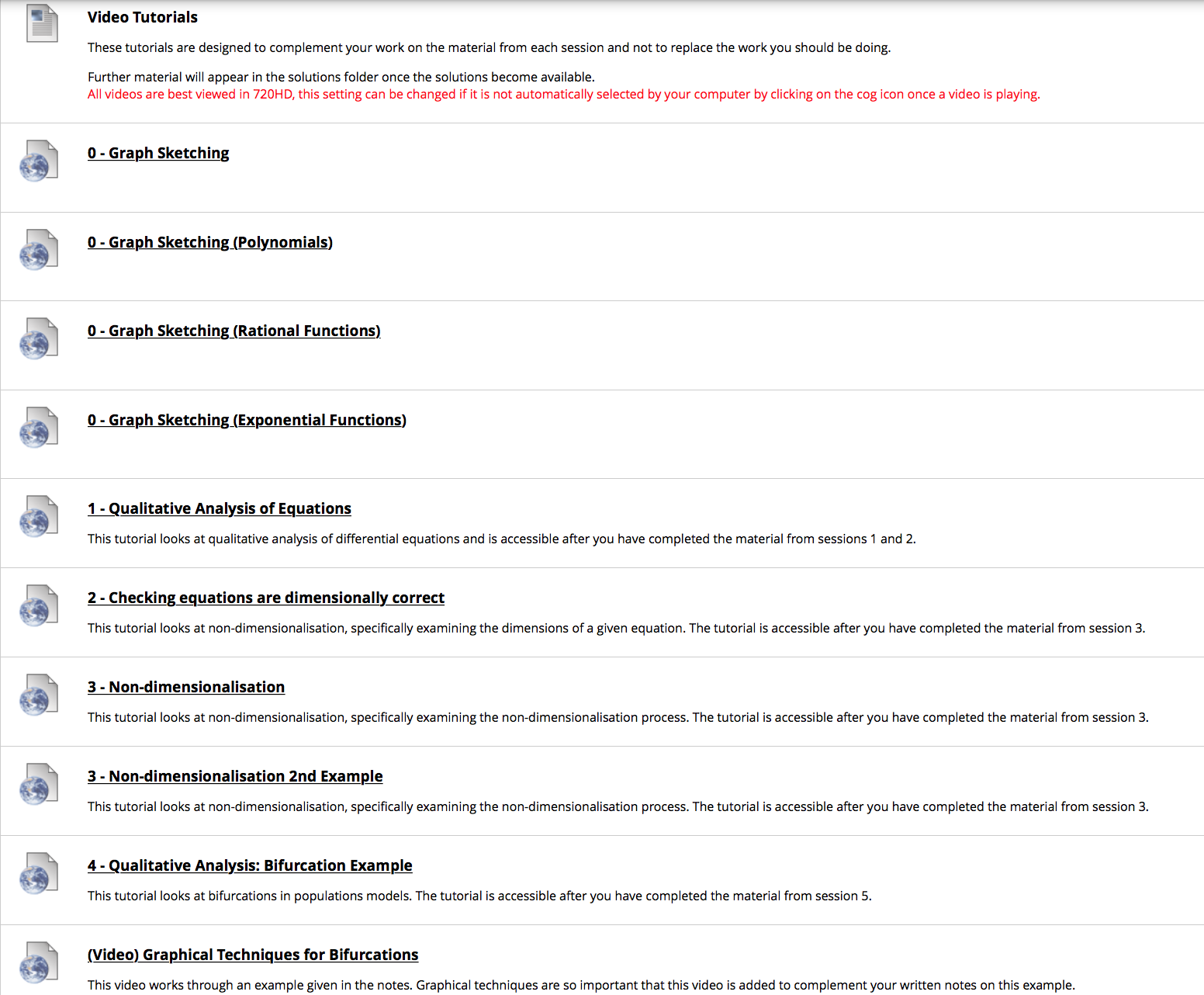
Video tutorials and problem-classes. I wanted to increase student engagement with formative assessment. Using Tablet PCs, screencast technology, YouTube and the KLE I created pre-recorded online classes. The classes’ structure consists of online tutorials, supporting formative assessment material together with online feedback on the formative assessment. Learners engage with the content at their pace and can move onto a new tutorial when they judge they have achieved particular outcomes. The aim being for students to regulate their learning.


Example suite of video tutorials for a mathematics module.


Example tutorial videos and support materials. This tutorial covers the “Video Tutorial for Interacting Species” in the previous image.


Equipment requirements: A standard Tablet PC with stylus and screen recording software such as Camtasia or Snagit.

Departmental impact: Other members of the mathematics department now create video tutorials for their modules. I supported and mentored staff in the use and development of materials. The department currently has 765 videos that include feedback and tutorials. The analytics demonstrate student engagement that presently stands at 108,000 minutes watched from 23,500 video views. (These videos are only available to Keele mathematics students registered on the relevant modules.)

Multimedia-based assessment. I took the Keele-led in a National HESTEM Programme Grant on ‘Mathematical Modelling and Problem Solving’. The project’s primary aim was to aim to create a sustainable model that provides STEM undergraduates with the transferable skills and abilities to solve real-world problems. To meet this aim I designed a new module where students needed to create creative instructional videos that demonstrate the solutions to problems. The grant funded video cameras with students using free software to edit their creations. Students participated in the evaluation of each other’s presentation, with the department’s academic staff acting as facilitators and possessing the final say on marks. This approach provides a variant on Adaptive Comparative Judgement (ACJ) which is relatively untested in mathematics but has been employed in less creative settings7. The ACJ variant used is appealing since it is well suited to assess creativity and I wanted to determine its applicability as a peer-assessment tool. Engagement with this assessment was phenomenal. In all cases, students not only solved complex mathematical problems but provided incredibly creative video presentations of their work.

The video cameras found a second use. The School provides these to students preparing for presentation as a self-reflection tool so that they can film, watch and reflect on their presentations, creating their formative self-assessment.

Equipment requirements: Purchasing video cameras is optional; more recently, students use their mobile phones and free editing software. There is more to say, for example, recent developments include using YouTube's live streaming facility to escape from a physical classroom. Recognising there is more to say and looking back reveals the ever-changing ability for technology to enhance both the student and staff experience. The enhanced student experience is summarised by the words of a current student's response to their learning experience that "...brings Keele maths department into the 2010s." For me, technology has improved not only my practice, not only regarding student education but also my ability to effectively focus on education rather than just writing. It is worth closing by reminding ourselves that technology is one of many tools available to us and we must always be mindful of the words "the right tool for the right job".

1Phhere. (2017). The free high-resolution photo of writing, blackboard, math, research, text, handwriting, mathematics, lecture, presentation, insight, chalk board, abstract algebra, critical thinking, definitions, propositions, deductive reasoning. [Online] Available from: https://pxhere.com/en/photo/973959 Accessed: 14 February 2018.
2Wittgenstein, L. (1978). Remarks on the Foundations of Mathematics. Oxford:Basil Blackwell.
3Mason, J. (2002). Mathematics Teaching Practice: A Guide for University and College Lecturers. UK: Horwood Publishing Limited.
4D. O. Tall, D. O. and Mejia-Ramos, J. P. (2006). The long-term cognitive development of different types of reasoning and proof. In Hanna, G., Jahnke, H. N., and Pulte, H., editors, Conference on explanation and proof in mathematics: Philosophical and educational perspectives, pages 1 – 11. Universiat Duisburg-Essen, Campus Essen.
5Thorne, K. (2003). Blended learning: How to integrate online and traditional learning. Kogan Page, London.
6Greiffenhagen, C. (2014). The materiality of mathematics: Presenting mathematics at the blackboard. The British Journal of Sociology, 65(3):502–528.
7Jones, I. and Alcock, L. (2012). Summative peer assessment of undergraduate calculus using adaptive comparative judgement. In Iannone, P. and Simpson, A., editors, Mapping University Mathematics Assessment Practices, chapter 17, pages 63 – 74. University of East Anglia.

Creative Commons License
My experiences with technology-enhanced learning, B by y Martyn Parker, School of Computing and Mathematics, Keele University is licensed under a Creative Commons Attribution-ShareAlike 4.0 International License.

Friday, 23 February 2018

The oxymoron of time-efficient teaching.


by Rebecca Laycock, Teaching Fellow in Environment and Sustainability, Keele University

Bekki is a previous winner of the Keele excellence awards more details can be found here

In the autumn semester 2017 I was faced with one of my biggest challenge I’ve had to deal with so far as a teacher. When I first started teaching it was expected that I would take more time to prepare for classes, be less efficient, and make more mistakes. It’s part of what it means to start something new.
picture of  a busy classroom with a plant in the foreground and blurred faces of students behind it
My first real teaching experience was a condensed two-week module taught in Nanjing, China at part of an international collaborative undergraduate programme in Environment and Sustainability. I have since taught this module two more times. 


But having completed over a year of teaching, I was starting to feel like a real teacher - not just someone faking it at the front of the class. And since I was a real teacher, there were certain expectations that were attached to this newfound credibility… one of which was that I needed to do more with less time. Fair enough, I thought. I am a real teacher now. So, I started finding ways to cut corners. My challenge became how can I deliver a quality educational experience as efficiently as possible?

Around this time, I also took on a role in the HEFCE-funded ‘Unmaking Single Perspectives: A Listening Project’. The aim of the project was to support students develop their listening skills. The rationale behind it was that, in spite of being an important communication skill, there is far greater emphasis on teaching students to argue a point than on how to be an effective listener.


Student Advisor Roxy Birdsall talks about her experience being involved with Unmaking Single Perspectives: A Listening Project

So what is listening? It’s more than hearing. You need to open a space for another person to speak. Because of this, listening is more than sitting and being quiet while another person talks. Listening uses your whole body. You use your ears to hear, sometimes you look at the person to read their body language - and you use your whole body too, to show the other person that you are listening. All of this enables them to openly share their thoughts.

Listening is challenging mental work because it isn’t passive – it requires physical and mental engagement. You need to be taking in what the other person is saying (though their words and tone of voice), and you need to be quick thinking enough to respond and probe thoughtfully without letting your own thoughts prevent you from listening, all whilst reading and responding to their body language.

Before getting involved in the Listening Project, I hadn’t reflected much on listening in the context of my role as a teacher. But before long, I became conscious of the range of listening skills that are required in all different modes of teaching, from lectures, to seminars, to one-on-one support. I came to be especially aware of listening in a particular type of one-on-one teaching interactions: meetings with dissertation students. My meetings with my dissertation students usually ran between 15 and 45 minutes, depending on their needs, the stage they were at, and their English language skills. I started arranging these meetings back to back to save time and to limit the length of the meetings.

But it didn’t feel right. It was utterly draining, and as a result I wasn’t able to listen properly to the students. My patience waned. I heard myself telling them what to do rather than asking questions to find out what they really meant. This was one area of my teaching that I couldn’t seem to make more efficient.

This push for efficiency, this challenge I was being faced with as a ‘real’ teacher, is a manifestation of the demand of the neoliberal university which asks academics to do more and more with less. This was (and is) a model I can’t make sense of – it is unsustainable to expect more efficiency year on year.

In the face of this apparent oxymoron, I found an article by Alison Mountz and her colleagues who were making a case for an alternative. They argued to slow down and claim time for slow scholarship as an in the face of a fast-paced, metric-oriented neoliberal university. I was heartened by this idea. Like them, I feel that slowing down represents a commitment to good scholarship, teaching, and service, and a collective feminist ethics of care that challenges the accelerated time and elitism of the neoliberal university (emphasis mine).

Like them, I am in favour of a fundamental restructuring of the university as a workplace

and learning environment, but this isn’t something that can be done overnight. This is why they suggest ways academics, as individuals and as a community, can take steps towards change. They say to take time for your work. Reach for the minimum (rather than maximum) level of achievement in order to produce quality rather than quantity. Say no to more work. Don’t respond you your email at all hours. All of these actions provide space to become a better listener, and a better teacher.

I help tend to the student-run beds in Walled Garden on Fridays. This is where some of the most genuine and productive conversations I’ve had with students have taken place. I attribute much of this to the fact that the conversations aren’t time-restricted or purpose-driven. [Photo by Greenie Mine]

It must be said that I do feel there are ways to be an efficient teacher. I usually take an afternoon walk to clear my head, so scheduling dissertation meetings either side means that I can have some mental respite before resuming the taxing challenge of listening. And it’s true that I need less time to prepare for lectures and seminars I have already delivered. But at some point, we need to recognise that the reality is this: a good teacher is not one who can be increasingly more and more efficient. Being a good teacher requires effective listening, and effective listening requires time. And there is no room for compromise.

To find out more about Unmaking Single Perspectives: A Listening Project click here, and click here to see their upcoming events.

Disclaimer: This post has also been made available at the Listening Project’s Blog.

Reference

Mountz, A., Bonds, A., Mansfield, B., Loyd, J., Hyndman, J., Walton-Roberts, M., ... & Curran, W. (2015). For slow scholarship: A feminist politics of resistance through collective action in the neoliberal university. ACME: An International Journal for Critical Geographies, 14(4), 1235-1259.


Creative Commons License
The oxymoron of time-efficient teaching. by Rebecca Laycock, Teaching Fellow in Environment and Sustainability, Keele University is licensed under a Creative Commons Attribution-NonCommercial-ShareAlike 4.0 International License.
Blog also available at https://usplisteningproject.wordpress.com/.

Friday, 3 March 2017

Making feedback more rewarding for everyone. Dr Julie Hulme


This blog post has been contributed to Solutions by Dr Julie Hulme a Principal Fellow of the HEA, a National Teaching Fellow and Keele Excellence award winner. More about Julie can be found here

The National Student Survey has made universities look carefully at the feedback provided to students, and most have implemented initiatives to improve students’ satisfaction (which has nonetheless remained stubbornly low). This can be a source of frustration for academics, who note glowing external examiners’ reports, hours of diligent commentary on their students’ work, and then rage that some students never read their feedback.

As a psychologist, this piques my curiosity. How can students be dissatisfied with something that should help them to learn (and get better marks)? How can academics believe that they are doing a great job, and yet deliver something that is so fundamentally flawed that students don’t even bother to read it? There appears to be a communication problem, and further investigation is needed.

Since the communication problem exists on both sides of the feedback equation, I carried out some research addressing both student and tutor perspectives. Most previous research offered insight into the ways in which students thought we could improve, but tutors were left reeling at the prospect of ‘doing more’ within an already busy job. Could we get more effective AND more efficient?

I used a mixed methods approach, combining surveys and focus groups, to investigate the perceived purposes of feedback, what people thought helped learning, and how feedback was used. The results offered a surprising degree of agreement between students and tutors, and allowed me to generate a set of recommendations, which I shared with volunteer participants online. They commented on and amended the recommendations, until they reached a consensus.

So, what can we do to make the feedback process more satisfying, and less frustrating, for everyone concerned? Let’s start with what tutors can do:

  • Students value three types of feedback: what they do well, what can they improve, and how they can improve. My research shows that tutors tend to focus on what is wrong – but guidance on how to improve is the hardest type of feedback to give, but the type that is most useful. Practically, how do you expect the student to provide ‘more depth’? I now provide structured feedback under these three headings.

  • Don’t give feedback on every mistake; pick the issues that are causing the most problems, and give detailed and constructive feedback about these (for writing errors, point students at Student Learning – this will save you time, and get them some expert help, while avoiding them feeling ‘picked on’).

  • Remember your audience – we sometimes use comments to justify our marks for the second marker. But students may not understand academic ‘short hand’; what is ‘depth’, anyway? Use language that will engage and develop them. 

  • Audio comments can help to make feedback feel personal and make it more accessible.

  • Early in the course, talk to your students about how to use feedback as a tool for learning; feedback in schools and colleges is very different, so they need to learn a new approach.

  • Identify yourself - sign or initial your marking so that students know who to ask if they need any clarification.

And what can students do?

  • Firstly, read your feedback! It gives you insight into how to improve your grades in future, and, according to Hattie (1987), is the most important way you can improve your learning.

  • But don’t read it instantly. When you first get work back, you’ll be emotional. Either you’ll be dancing around celebrating, or you’ll react defensively to the feedback. Give yourself time to calm down and reflect; look for the information that tells you what you do well, what to improve, and practically, how you can get better (even if this isn’t written explicitly). Devise an action plan and follow it!

  • If you’re not sure how to use your feedback, ask for an appointment with the tutor who marked your work, and ask for their help. Communication is much clearer in person, and misunderstandings can be avoided. If still in doubt, pay a visit to Student Learning for more advice.

The important thing, whether you’re a tutor or a student, is to remember that feedback involves two people. Sharing responsibility for the communication process ensures that feedback is useful, valued, and facilitates learning. Applying these principles certainly makes feedback delivery more rewarding for me, and my students often give me positive feedback on my feedback!


Hulme, J.A. and Forshaw, M.J. (2009). Effectiveness of feedback provision for psychology undergraduate students. Psychology Learning and Teaching, 8, 1, 34-38.

Creative Commons License
Making feedback more rewarding for everyone by Dr Julie Hulme, Keele University is licensed under a Creative Commons Attribution-NonCommercial-NoDerivatives 4.0 International License.
Based on a work at https://lpdcsolutions.blogspot.com.